
FAQs
1. Why should I ask about a dog trainer or behaviourist’s qualifications?
That’s a great question — and an important one!
The dog training and behaviour industry is largely unregulated, which means anyone can call themselves a trainer or behaviourist, regardless of their background or methods. Asking about qualifications helps ensure you're working with someone who is knowledgeable, ethical, and up to date with modern, science-based approaches.
Here’s why it matters:
- Expertise you can trust: Qualified professionals have studied animal behaviour, learning theory, and ethical training methods. They know how dogs learn and how best to support both you and your dog.
- Science-based, kind methods: With the right training, professionals use force-free techniques that focus on building trust, giving your dog choice, and creating lasting results — without fear or harm.
- Your dog’s safety and well-being: Without proper knowledge, well-meaning advice can unintentionally cause more harm than good. Qualifications show a commitment to doing things the right way.
- Better support for you: A qualified trainer not only works with your dog but also helps you build the skills and confidence to continue progress at home.
- Ongoing education: Many certified trainers and behaviourists commit to continuous learning so they can offer the most up-to-date, effective, and compassionate support.
When in doubt, don’t be shy to ask! It’s not rude — it’s responsible. You’re your dog’s advocate, and making sure they’re in good hands is part of giving them the best care possible.
...........................................................................................
2. What are your qualifications and what do they mean?
I have a B.Soc.Sc nursing degree, as well as a B.Cur.IetA degree in operating theatre and management. Although these are not directly aligned with my current vocation, they do offer a me a unique ability into the human part of my day as I worked closely with people for most part of my career-life.
I have done a basic and advanced certificate in Canine Behaviour through the Ethology Academy associated with Onderstepoort and I recently obtained my DipCABT (Diploma in Companion Animal Behaviour Therapy) through COAPE International which qualifies me as a COAPE Certified Animal Behaviourist (C.C.A.B).
This means I am qualified to work with companion animals on a variety of behaviour problems, not only on dogs. However, my passion is with dogs and thus I work with them more often.
I regularly do training courses online through various people in order to grow my own knowledge base and keep up to date with the latest science and methods.
...........................................................................................
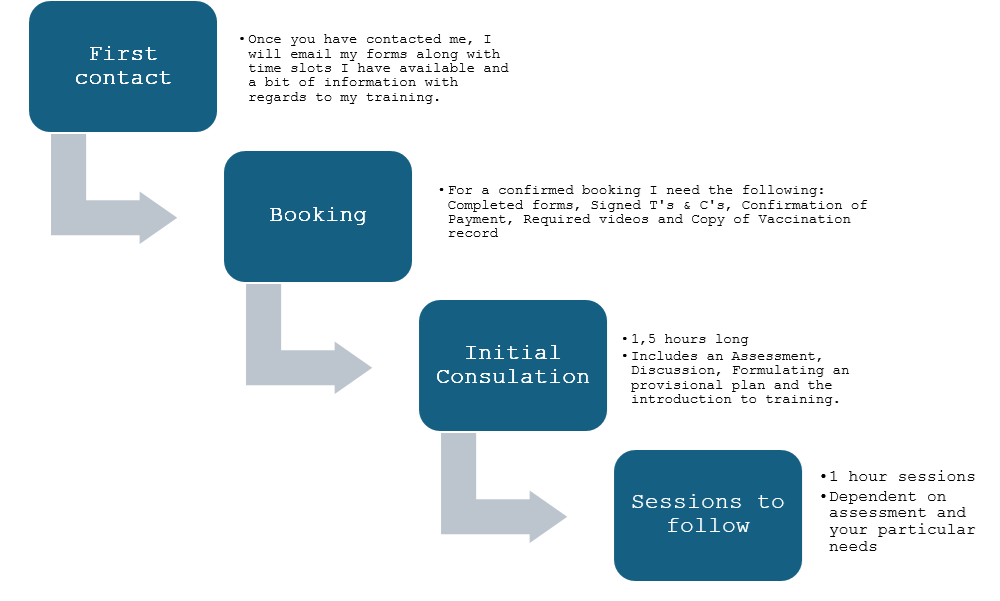
3. What is your process?
...........................................................................................
4. How do I book a session?
You can contact me through my website, send me an email, or give me a call. I also offer a free discovery call to chat about your dog and recommend the right plan.
...........................................................................................
5. Which methods do you use?
I seek to improve the connection between you and your dog through scientific-based, force-free methods that consider your dog’s happiness, wellbeing, confidence & safety. That means we focus on rewarding good behaviour rather than punishing unwanted behaviour. No harsh tools or outdated dominance-based methods — just kind, effective training.
All animals are sentient beings, just like us. If you want to succeed at building a strong bond with your dog, respect and understanding will be the only way forward.
Training is not about getting your dog to perform ‘commands’ but rather for you and your dog to enjoy the process of learning together. To have a dog that engages with you and can focus and respond to your cues, starts with building that bond.
Each home has its own ways of functioning and can be as different as our personalities are from each other. We need to guide our dogs how to function and not only survive, but thrive in the environment we have chosen for them.
When it comes to behaviour sessions, I make use of MHERATM which is an assessment and therapy tool based on the emotional well-being of the animal.
...........................................................................................
6. Would my dog need training or behaviour modification?
All my behaviour modification plans include training aspects. Whether or not, your dog needs behaviour modification will depend on the outcome of the history taking and assessment.
Sometimes dogs present with a behaviour problem that is actually just a miscommunication and can be solved with training. Other times, training will not be enough and a behaviour modification plan will be needed.
...........................................................................................
7. How many sessions would we need?
For training clients seeing me for the first time, I recommend 6 sessions to start off with. This will be the initial consultation plus 5 more sessions and will cover everything you need to have a well-rounded training foundation. From there we can book sessions as and when you need depending on whether it is recapping or progressing in training.
Training sessions are done 1 or at most 2 weeks apart. Weekly sessions are great for accountability, but because life does happen and schedules can get hectic, a session every 2 weeks works well. I do not recommend having a bigger gap between sessions (this does not include single recap sessions).
Behaviour sessions depend on the problem presented and because it can be so uniquely different, will be estimated during our initial consultation. I will make a recommendation and we will plan together. Behaviour modification is different for every dog and sessions can vary as we move forward. Some dogs surprise us and grow quickly, and others need a bit more time.
...........................................................................................
8. How long will it take to see results?
That depends on your goals, your dog’s temperament, and consistency at home. Some behaviours improve within a few sessions, while more complex issues take time. I will give you realistic expectations and support you every step of the way.
...........................................................................................
9. Where does the training take place?
I offer in-home training or outdoor sessions in real-world environments depending on what is needed.
...........................................................................................
10. Why private sessions?
- Done in the comfort of your own home
- Saves time getting everyone ready and driving around
- Training plan and behaviour strategies are formulated around the layout of your living space
- Your dogs are more comfortable in their own space
- We train in the areas where they need to be
- Any extras that come up can be dealt with in the moment
- Personal and focussed solely on you and your dog
- Less distractions, more progress
- More compact sessions
...........................................................................................
11. What age should I start training my dog?
It’s never too early or too late! Because I do private training, and it is done in your home, puppies can start training as early as 8 weeks old. Older dogs can absolutely learn too — we tailor our approach based on your dog’s age, breed, and needs.
...........................................................................................
12. Do you train the dog or teach me how to train my dog?
Both! My goal is to give you the tools and knowledge to confidently work with your dog. I will coach you every step of the way, but your involvement is key to long-term success.
...........................................................................................
13. What should I prepare for a session?
- More than enough treats, varying in level of value
- Treat pouch
- Walking apparel: harness and standard leash
- Portable water bowl with water when working outdoors
...........................................................................................
14. What is your cancellation/rescheduling policy?
I ask for at least 24 hours' notice for cancellations or rescheduling. Late cancellations will be subject to a fee. I understand life happens — just keep me in the loop!
...........................................................................................
15. Do you work with aggressive or reactive dogs?
Yes! I work with behaviour issues, including fear, reactivity, and aggression. We use positive reinforcement and behaviour modification techniques to help your dog feel safe and confident.
...........................................................................................
16. With which breeds do you work?
I work with any and all dog breeds. I have already worked with most of the common breeds you find in South Africa, and if I come across a breed I have not worked with, I do extensive research.
However, my methods allow me to meet the dog in front of me, despite their breed or classification.